
Modern landfill construction involves much more than simply containing waste. Today, environmental regulations require engineered systems that protect groundwater, control leachate flow, manage landfill gas, and maintain long-term structural stability.
As landfill facilities grow in size and complexity, geosynthetic materials have become essential parts of modern containment systems. Among these materials, Geotextile Membrane Systems play a vital role in filtration, separation, protection, drainage, and reinforcement throughout landfill infrastructure.
In addition, modern landfill engineering combines Geotextile Membrane Systems with geomembranes, drainage geocomposites, geogrids, and other geosynthetics to create complete containment systems. Together, these solutions improve environmental protection, increase operating efficiency, and support long-term landfill performance.
At MEGS, we integrate Geotextile Membrane Systems into complete geotechnical and environmental engineering solutions that improve landfill performance and support sustainability. Moreover, we combine filtration geotextiles, STRATADRAIN® drainage geocomposites, geogrid reinforcement, and engineered landfill capping systems to deliver reliable solutions for demanding site and loading conditions.

Why Geotextile Membrane Systems Are Essential in Landfill Construction
Landfill facilities face many engineering challenges throughout both operation and long-term closure.
These challenges include:
- Leachate generation
- Groundwater protection
- Differential settlement
- Waste loading
- Landfill gas management
- Surface erosion
- Slope instability
- Long-term environmental exposure
Without proper geosynthetic systems, these conditions can reduce containment performance and increase environmental risks.
Therefore, Geotextile Membrane Systems create strong interfaces between soil layers, drainage systems, geomembranes, and structural elements throughout the landfill.
Because they perform several engineering functions at the same time, they have become essential components of modern landfill design.
Functions of Geotextile Membrane Systems in Landfills
Filtration
One of the main functions of Geotextile Membrane Systems is to maintain filtration while allowing water to pass through the system.
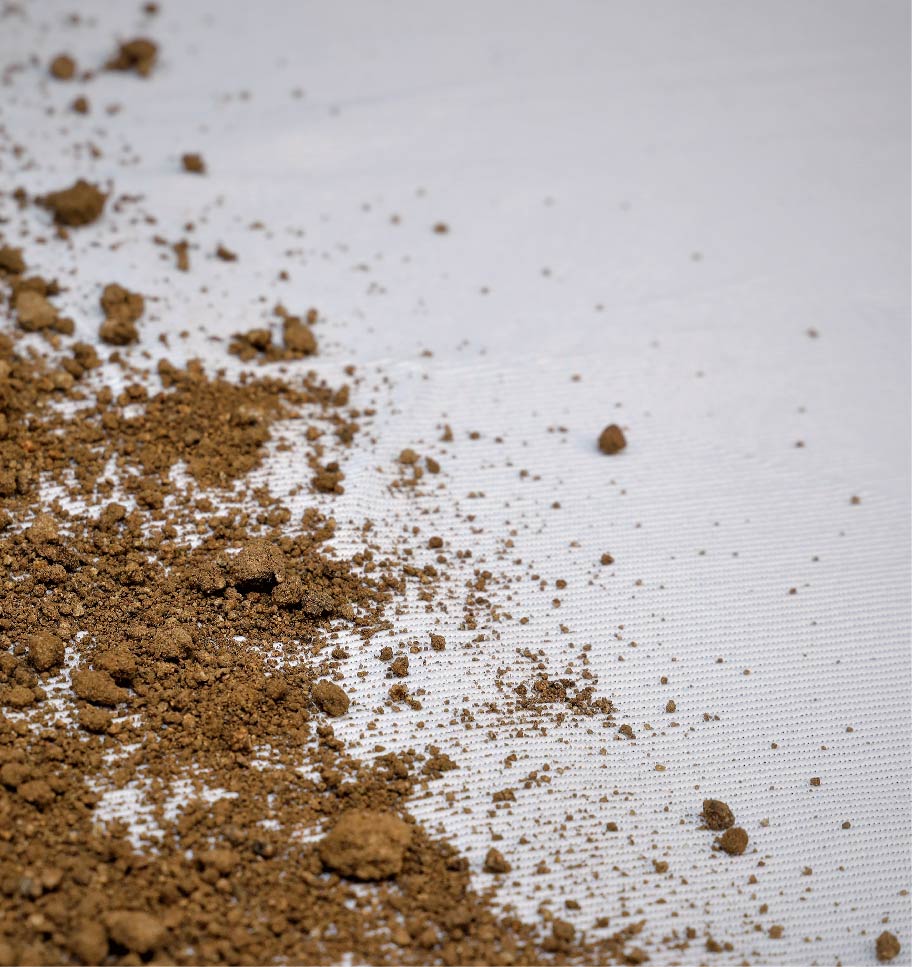
Engineers select filtration geotextiles to allow water flow while preventing fine soil particles from entering drainage layers.
Proper filtration helps prevent:
- Soil particle migration
- Internal erosion
- Drainage clogging
- Reduced hydraulic performance
As a result, filtration geotextiles preserve drainage paths and improve long-term landfill performance.
Separation
Geotextile Membrane Systems separate different materials and help each layer maintain its engineering properties.
For example, they prevent mixing between:
- Drainage aggregate and surrounding soil
- Cover soil and waste
- Structural fill and subgrade
Consequently, separation improves drainage, supports better load distribution, and extends system life.
Protection
Landfill liner systems provide the primary environmental barrier inside a landfill.
To protect these barriers, engineers install Geotextile Membrane Systems above and below geomembranes and HDPE liners. These layers cushion the liners and reduce the risk of puncture damage.
Modern landfill liners often combine HDPE geomembranes, protective geotextiles, and geosynthetic clay liners (GCLs) to create highly effective composite barriers.
This protection helps:
- Reduce stress concentrations
- Prevent liner punctures
- Improve long-term liner performance
- Strengthen environmental protection
Reinforcement
In some applications, Geotextile Membrane Systems help spread loads and improve soil stability.
However, projects that require high tensile strength usually combine geotextiles with geogrid reinforcement systems.
This approach is common in:
- Landfill access roads
- Working platforms
- Soft ground areas
- Reinforced cover systems
- Slope stabilization
As a result, reinforcement improves soil strength, limits deformation, and increases long-term stability.
Drainage Performance and Leachate Management
Drainage remains one of the most important parts of landfill engineering.
Poor drainage allows leachate to build up and increases hydraulic head above liner systems. Consequently, higher leachate levels reduce containment efficiency, increase leakage risk, and create environmental concerns.
Furthermore, excess water raises pore water pressure and lowers effective stress within the soil. According to Terzaghi’s effective stress principle (σ’ = σ − u), lower effective stress reduces soil strength, bearing capacity, and slope stability.
As a result, poor drainage may lead to:
- Slope instability
- Cover system deformation
- Excessive settlement
- Reduced bearing capacity
- Long-term landfill performance problems
Therefore, Geotextile Membrane Systems help maintain drainage by preserving filtration and keeping water flow paths open throughout the landfill.
When combined with engineered drainage systems, they help:
- Protect groundwater
- Control leachate flow
- Maintain hydraulic performance
- Reduce hydraulic head on liner systems
- Reduce pore water pressure
- Improve long-term landfill stability

STRATADRAIN® Drainage Geocomposites in Landfill Applications
Modern landfill design increasingly relies on drainage geocomposites to replace conventional aggregate drainage layers.
STRATADRAIN® systems combine geotextile filtration layers with a high-flow drainage core to create efficient drainage pathways within a compact profile.
Compared with traditional aggregate drainage systems, STRATADRAIN® offers:
- High transmissivity performance
- Reduced material requirements
- Faster installation
- Consistent hydraulic behavior
- Lower transportation costs
- Reduced construction footprint
In landfill applications, STRATADRAIN® systems are commonly used for:
- Leachate collection systems
- Cover system drainage
- Side-slope drainage
- Gas venting applications
- Groundwater management systems
In addition to liquid drainage, STRATADRAIN® systems may also facilitate landfill gas collection and venting within engineered cover systems, helping maintain environmental compliance and long-term containment performance.
By maintaining continuous drainage pathways, STRATADRAIN® helps preserve long-term landfill performance while reducing maintenance requirements.
Geotextile Membrane Systems in Landfill Capping
Landfill performance does not end when waste placement is complete.
Final cover systems must continue protecting the environment for decades after closure.
Landfill capping systems are designed to:
- Minimize water infiltration
- Reduce leachate generation
- Control erosion
- Support vegetation establishment
- Maintain long-term stability
- Protect environmental containment systems
Geotextile Membrane Systems play an important role within landfill capping assemblies by providing filtration, separation, drainage, and protection functions.
These systems help preserve drainage performance while protecting underlying barrier layers from mechanical damage.
Long-term stability of landfill cover systems depends not only on soil strength but also on interface shear resistance between geosynthetic layers. Interface stability analysis is therefore a critical component of landfill slope design and helps prevent translational failures along geosynthetic interfaces.
Geogrid Reinforcement for Landfill Cap Stability
One of the major challenges in landfill capping is maintaining stability on steep side slopes.
Settlement, erosion, and environmental loading can create instability within cover systems if reinforcement measures are not properly incorporated.
Geogrid reinforcement systems are often integrated into landfill cap designs to improve slope stability and soil confinement.
The geogrid reinforcement mechanism helps:
- Improve tensile resistance within cover soils
- Reduce surface movement
- Increase slope stability
- Improve load distribution
- Enhance long-term cap performance
The required reinforcement strength is governed by loading conditions, cover soil thickness, slope geometry, settlement potential, waste mass deformation, and long-term creep considerations.
In many landfill projects, geogrid reinforcement is combined with interface stability analysis to ensure adequate resistance against translational failures along geosynthetic interfaces.
This reinforced earth approach is particularly beneficial on steep landfill slopes where conventional soil cover systems may be vulnerable to movement.

Foundation Improvement Considerations
Some landfill developments are constructed over soft or compressible foundation soils that may experience settlement under long-term waste loading.
In these situations, geogrid reinforcement, geotextile separation layers, and engineered drainage systems may be incorporated to improve load distribution, reduce differential settlement, and enhance overall foundation stability.
Ground improvement measures become particularly important where landfill facilities are developed over weak subgrades, compressible soils, or reclaimed land.
Long-Term Durability and Environmental Performance
Landfill systems are expected to perform for decades under changing environmental conditions.
Therefore, long-term durability is a critical design requirement.
Geotextile Membrane Systems used in landfill construction are selected based on:
- Tensile strength performance
- Puncture resistance
- Filtration characteristics
- Chemical resistance
- Biological resistance
- Creep performance
- Long-term durability
Proper material selection helps ensure that landfill systems continue functioning throughout the design life of the facility.
MEGS Approach to Landfill Geosynthetic Solutions
MEGS delivers integrated geotechnical and environmental engineering solutions for landfill infrastructure projects across Jordan and Saudi Arabia.
Services include:
- Geotechnical investigations
- Landfill engineering support
- Geosynthetic system selection
- Drainage design evaluation
- STRATADRAIN® drainage solutions
- Geogrid-reinforced landfill capping systems
- Material supply
- Installation supervision
- Quality assurance
- Technical support
Through its partnership with STRATA Geosystems, MEGS provides advanced geosynthetic technologies that improve environmental protection, operational efficiency, and long-term landfill performance.
Conclusion
Geotextile Membrane Systems are fundamental components of modern landfill construction because they provide filtration, separation, protection, drainage, and reinforcement functions within engineered containment systems.
Their integration with advanced drainage geocomposites such as STRATADRAIN®, composite liner systems, and geogrid reinforcement technologies creates highly efficient landfill solutions capable of managing leachate, protecting groundwater resources, maintaining slope stability, and supporting long-term environmental performance.
By combining geotechnical engineering expertise with advanced geosynthetic technologies, MEGS delivers landfill systems designed to achieve superior environmental protection, regulatory compliance, and long-term operational reliability.