
Overview of Gabion Retaining Wall Design
Gabion retaining wall design plays an important role in geotechnical engineering for slope stabilization, erosion control, and infrastructure protection. Engineers widely use these systems because they combine gravity resistance, internal friction, rock interlocking, and natural drainage.
From a geotechnical perspective, loading conditions control gabion wall stability. Earth pressure, surcharge loads, hydraulic forces, and soil strength influence stress distribution, deformation, and overall performance.
Unlike rigid concrete retaining walls, gabion walls consist of wire mesh baskets filled with angular stone that form flexible gravity structures. As a result, they accommodate settlement and ground movement without significant structural damage.
Together, self-weight, stone interlocking, internal friction, and hydraulic energy dissipation create a retaining system that performs well on weak foundations and in hydraulic environments.
These mechanisms include:
- Self-weight (gravity action)
- Internal friction between rock particles
- Interlocking and confinement of stone fill
- Hydraulic energy dissipation through voids
Together, these mechanisms make gabion retaining wall design suitable for weak soils, variable foundations, and hydraulic environments.
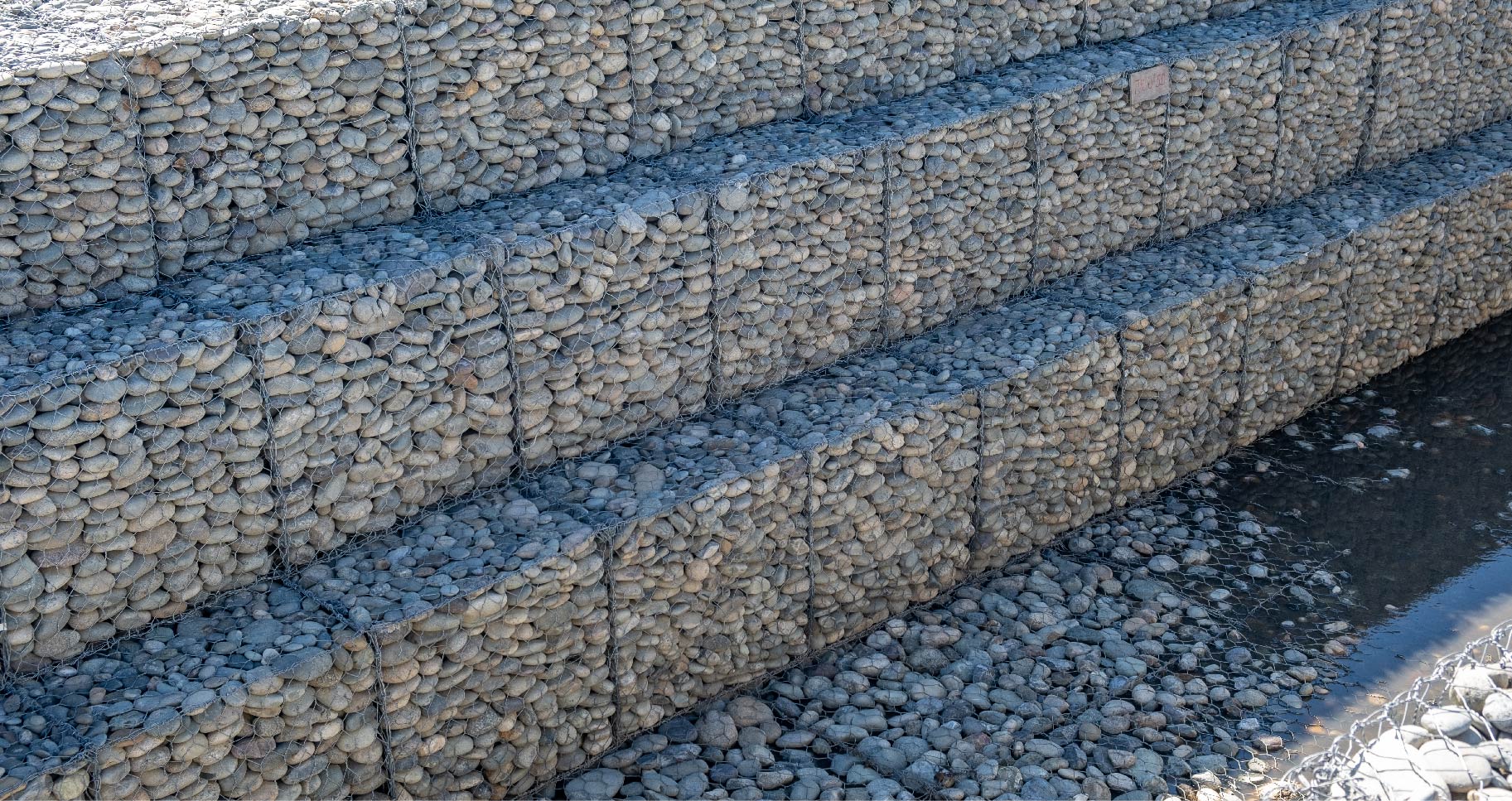
Earth Pressure in Gabion Retaining Wall Design
A fundamental step in gabion retaining wall design is evaluating lateral earth pressure.
Horizontal earth pressure depends on:
- Unit weight (γ)
- Internal friction angle (φ)
- Wall height and surcharge loads
- Groundwater and drainage conditions
Engineers apply Rankine or Coulomb earth pressure theories to calculate the forces acting on the wall. Consequently, they can size the gabion structure correctly and ensure long-term stability.
Stability Analysis in Gabion Retaining Wall Design
To achieve long-term performance, every gabion retaining wall must satisfy several geotechnical stability requirements.
Sliding Stability
Sliding occurs when horizontal earth forces exceed frictional resistance.
Resistance depends on:
- Self-weight of the gabion wall
- Base friction between the wall and the foundation
- Interlocking between gabion layers
Therefore, increasing the base width improves friction and reduces sliding risk.
Overturning Resistance
Overturning occurs when lateral forces create a larger overturning moment than the resisting moment.
Engineers control overturning resistance through:
- Weight distribution
- Wall geometry
- Position of the resultant force within the base
As a result, proper design keeps the wall stable against rotation.
Bearing Capacity and Soil–Structure Interaction
In addition, the foundation soil must safely support the loads transferred by the gabion wall.
Key considerations include:
- Soil bearing capacity
- Stress distribution beneath the wide gabion base
- Long-term settlement
- Soil–gabion interface friction
Because gabion walls spread loads over a wide area, they reduce stress concentrations on weak soils.
Moreover, soil–structure interaction depends on unit weight (γ), friction angle (φ), cohesion (c), groundwater conditions, and effective stress within the retained soil.
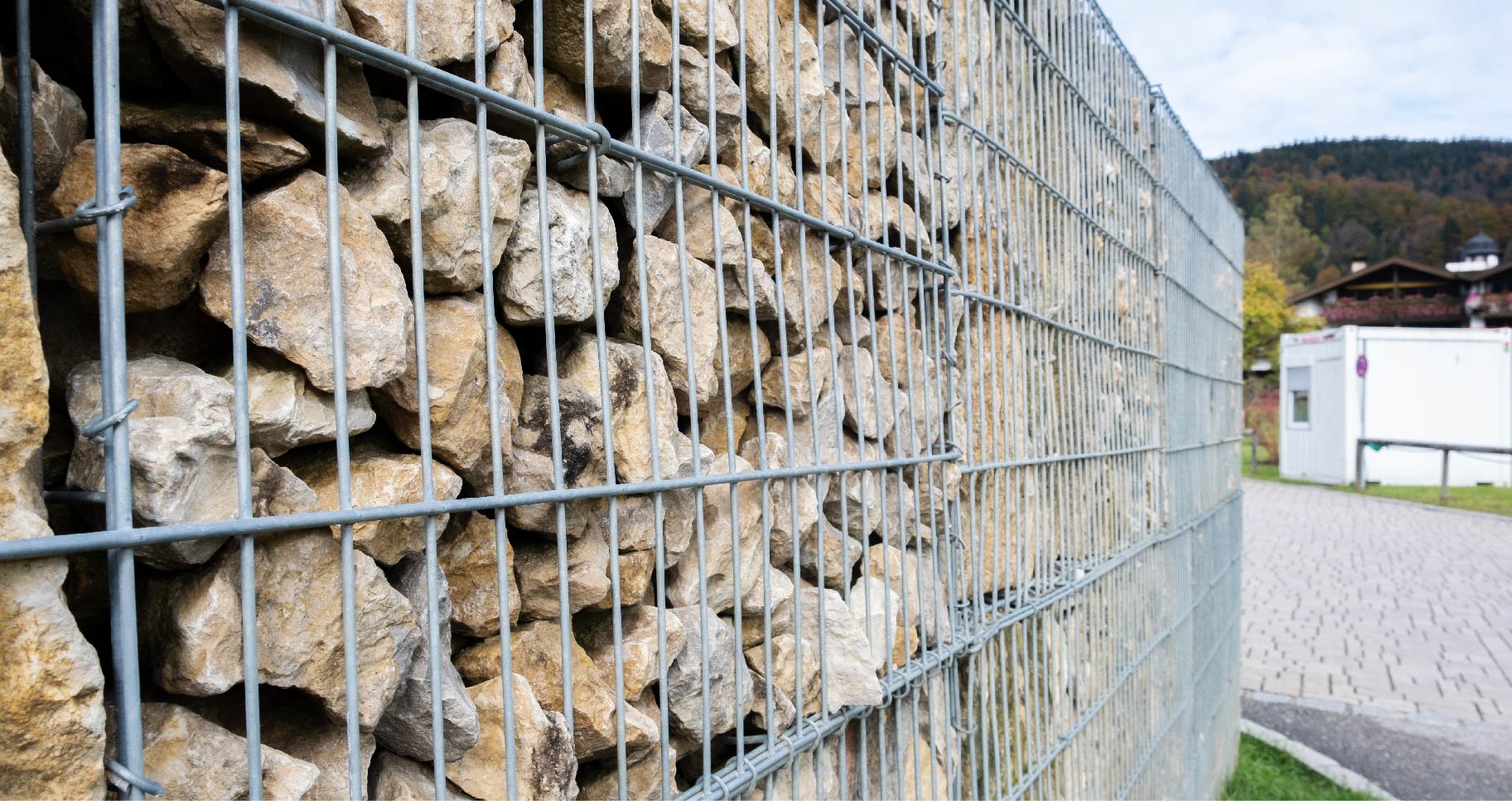
Internal Shear Resistance Mechanism
A critical mechanism in gabion retaining wall design is internal shear resistance.
This is achieved through:
• friction between angular rock particles
• mechanical interlocking of stones
• confinement provided by steel mesh cages
This internal resistance increases structural stability and deformation tolerance.
Hydraulic Energy Dissipation and Drainage Stability
Gabion systems are highly effective in hydraulic environments due to:
• reduction of water velocity through void structure
• dissipation of flow energy
• prevention of scour at foundation level
• protection of riverbanks and drainage channels
This makes gabion retaining wall design ideal for flood-prone and erosion-sensitive areas.

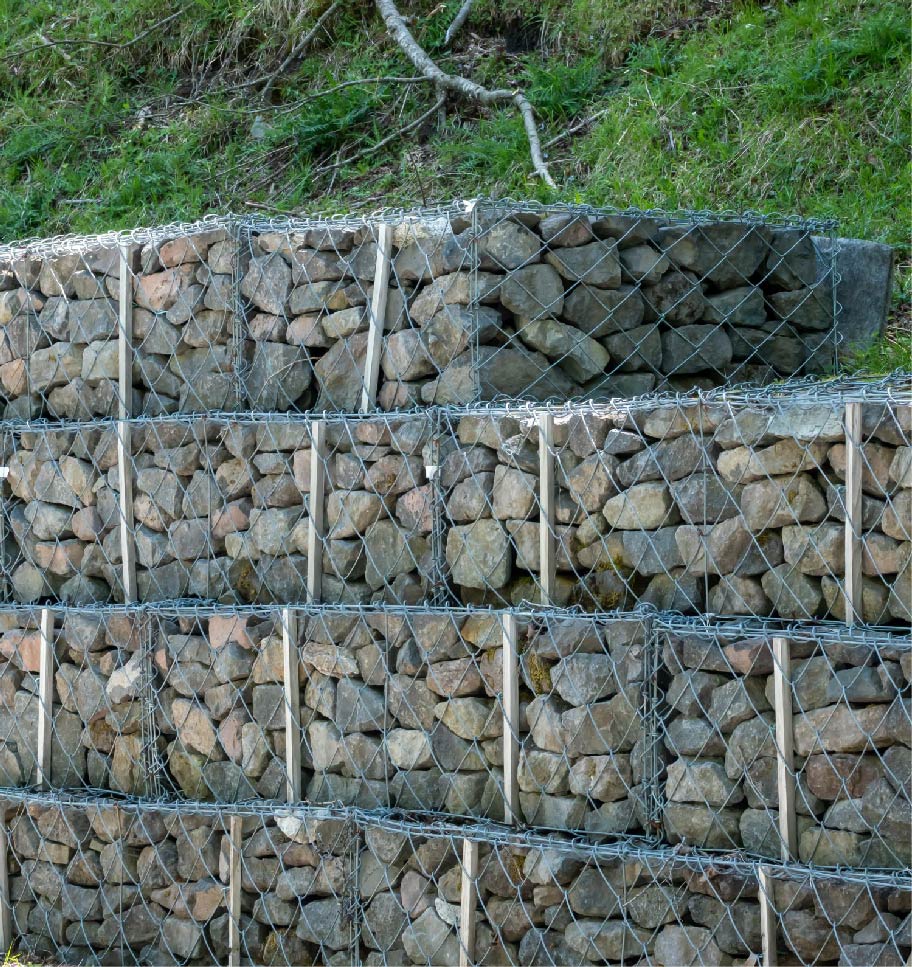
Effective Stress and Hydrostatic Pressure Control
The drainage capability of gabion systems plays a key role in maintaining effective stress conditions within the retained soil mass.
The permeable structure allows:
• free drainage through the wall system
• reduction of pore water pressure buildup
• maintenance of soil shear strength
• long-term geotechnical stability
Geotextile separation and filtration layers are commonly integrated behind gabion walls to prevent migration of fine soil particles while maintaining drainage efficiency.
Reinforced Earth Concept in Gabion Retaining Wall Design
In advanced geotechnical applications, gabion retaining wall design can be integrated with geogrid reinforcement to form a reinforced earth wall system.
In this system, geogrid layers are extended into the reinforced soil mass behind the gabion facing, creating a composite soil–reinforcement structure that significantly improves global stability and load distribution behavior.
The addition of geogrids provides:
• increased internal stability
• reduction in lateral earth pressure acting on the facing
• improved resistance against sliding and overturning
• enhanced performance on weak foundation soils
• reduction in the required gabion mass and wall depth
This approach allows the gabion facing to function mainly as a facing and confinement element, while the reinforced soil mass becomes the primary stabilizing mechanism.
As a result, the number of gabion boxes and overall wall footprint can be significantly reduced compared to conventional gravity gabion retaining walls.
This system combines:
• flexibility of gabion facings
• reinforcement behavior of geogrids
• drainage performance of granular backfill
• geotextile separation and filtration systems
• deformation tolerance of reinforced earth systems
making it highly suitable for roadway embankments, bridge approaches, slope stabilization, and infrastructure retaining structures.
This design philosophy is consistent with FHWA reinforced soil structure guidance and BS 8006 principles for reinforced earth and geosynthetic-supported systems.
Geometry in Gabion Retaining Wall Design
Proper geometry is essential for safe gabion retaining wall design.
Typical engineering guidelines may use base widths between 0.5H and 0.7H, depending on loading conditions, soil properties, and overall stability requirements. This range is not a fixed rule but a preliminary design reference that must be verified through detailed geotechnical analysis.
Additional design considerations include:
• stepped or battered wall configurations
• load distribution optimization in multi-layer systems
• embedment depth requirements
• hydraulic and scour protection considerations
The wall geometry and embedment depth shall be designed in accordance with FHWA principles and geotechnical engineering requirements.
For hydraulic and riverbank applications, the embedment depth must consider the expected scour depth level to prevent undermining of the foundation and loss of structural stability during erosion or flood events.
These proportions are adjusted based on:
• sliding stability
• overturning resistance
• bearing capacity
• global stability
• hydraulic loading conditions
• anticipated scour depth and erosion potential
Drainage Behavior in Gabion Retaining Wall Design
One of the strongest advantages of gabion retaining wall design is drainage performance.
The void structure allows:
• free water flow through the system
• elimination of hydrostatic pressure buildup
• maintenance of effective stress in retained soil
Geotextile filters are used to:
• prevent soil particle migration
• maintain long-term drainage efficiency
• avoid clogging of voids
Gabion Box Role in Retaining Wall Design
Gabion retaining wall design is based on modular units known as gabion boxes.
These units:
• are assembled on-site
• filled with angular rock
• stacked to form a continuous gravity system
Their flexibility allows performance under differential settlement and varying soil conditions.
Applications of Gabion Retaining Wall Design
Gabion retaining wall design is used in:
• roadway construction and embankments
• riverbank and hydraulic protection
• slope stabilization systems
• infrastructure retaining structures
• erosion-prone terrain stabilization
Working with MEGS
MEGS applies geotechnical engineering principles in gabion retaining wall design through a structured methodology that includes:
• evaluation of soil parameters (unit weight γ, friction angle φ, cohesion c)
• earth pressure analysis based on Rankine and Coulomb theories
• stability checks for sliding, overturning, and bearing capacity
• drainage and pore pressure control assessment
• selection of gabion geometry based on load and soil conditions
• reinforced earth design using geogrid systems when required
This ensures that gabion systems are designed as engineered soil–structure systems rather than empirical retaining solutions.
Conclusion
Gabion retaining wall design is a multi-mechanism geotechnical system governed by earth pressure, loading conditions, sliding resistance, overturning stability, bearing capacity, internal shear resistance, drainage behavior, and hydraulic performance.
The integration of geogrid reinforcement with gabion facings allows the system to function as a reinforced earth wall structure, reducing the required gabion mass while improving global stability and structural efficiency.
When properly designed according to FHWA principles and geotechnical engineering requirements, gabion systems provide durable, flexible, and environmentally efficient retaining solutions for modern infrastructure projects.