
Large transportation projects require reliable geotechnical engineering solutions to achieve long-term stability while making the best use of limited land. This case study highlights a geogrid installation completed at the Riyadh Metro Project in Riyadh, Saudi Arabia. MEGS worked with Strata Geosystems to build a vertical Mechanically Stabilized Earth (MSE) retaining wall that supports metro station access during construction.
The project shows how modern geogrid reinforcement systems create strong, cost-effective, and sustainable retaining structures. In addition, the system safely supported cranes and heavy construction equipment throughout the project.

Project Details
Location: Riyadh, Saudi Arabia
Client: Riyadh Development Authority
Application: Vertical Mechanically Stabilized Earth (MSE) Retaining Wall
Product Used: StrataGrid™
As part of the Riyadh Metro Project, engineers needed retaining walls to create safe and stable access roads to the metro stations. At the same time, the design had to reduce land use in busy urban areas.
Therefore, MEGS worked closely with Strata Geosystems to provide engineering support and advanced geogrid reinforcement. As a result, the team delivered a reliable retaining wall while meeting strict construction schedules.
Engineering Challenge
The Riyadh Metro Project is one of Saudi Arabia’s largest transportation developments. Consequently, it required advanced ground improvement and structural support.
The access roads needed vertical retaining walls that could stabilize soil while saving valuable construction space.
Key engineering challenges included:
- construction of vertical mechanically stabilized earth walls
- limited construction space in urban areas
- requirement for fast and efficient installation
- need for durable reinforcement systems capable of supporting long-term infrastructure performance (3 years)
These challenges required a carefully engineered retaining wall system supported by reliable geogrid installation techniques and comprehensive internal and external stability analysis.
Geogrid Installation for Reinforced MSE Walls
The project used StrataGrid™ geogrid reinforcement to strengthen the reinforced soil structure. This high-performance geosynthetic improves soil stability and provides tensile reinforcement inside the MSE wall.
With proper geogrid installation, the reinforced soil behaves as one stable structure that resists earth pressure and supports vertical wall construction.
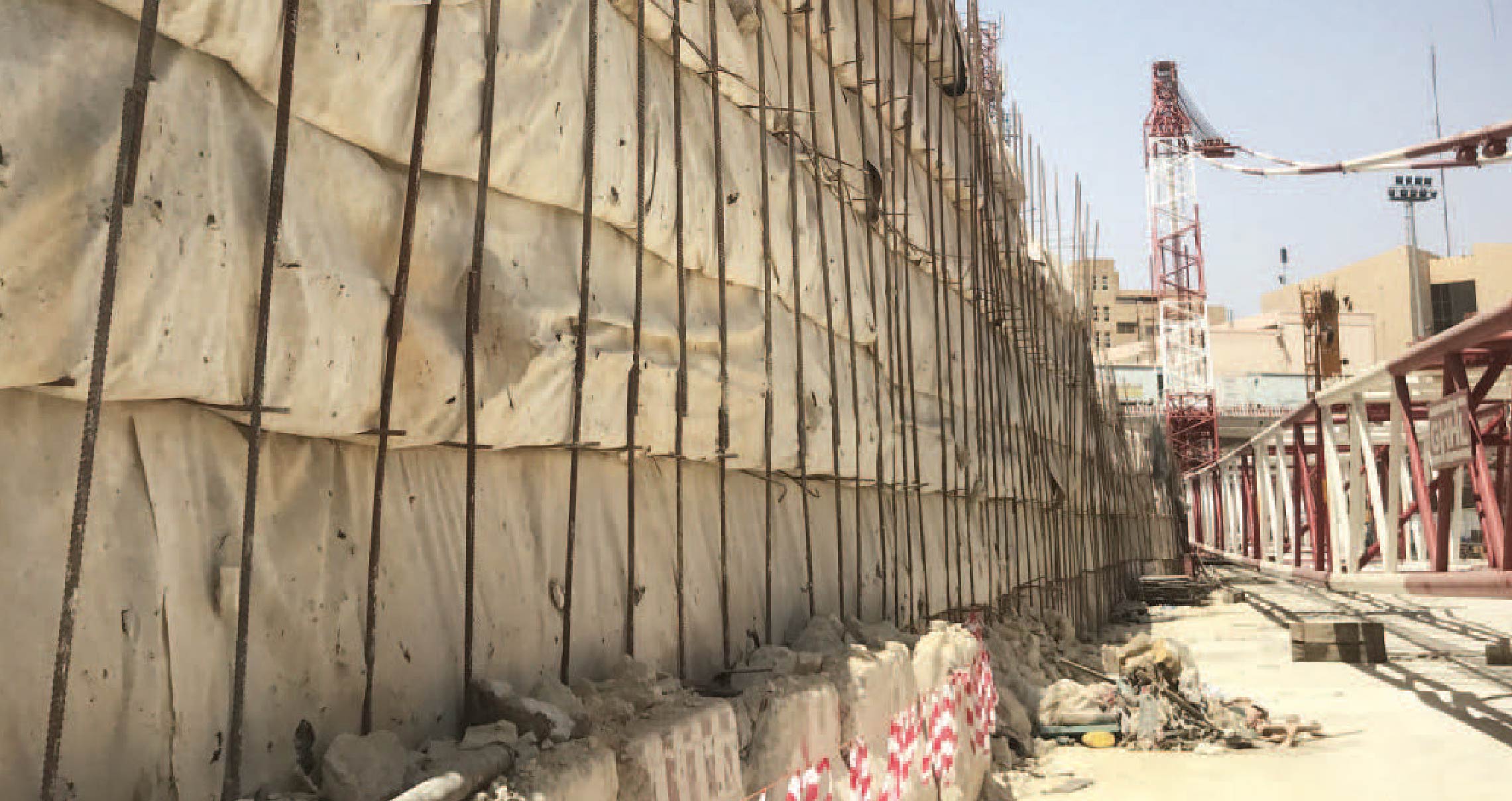
Geogrid Installation and Reinforcement Mechanism
The reinforced wall system included:
- layers of geogrid mesh installed within compacted soil
- reinforced soil zones forming a composite structural mass
- a vertical retaining wall configuration suitable for urban infrastructure
- controlled soil compaction to ensure optimal load distribution
- Jersey barriers as a lost formwork facing
As traffic and construction loads acted on the wall, the geogrid locked into the surrounding soil. Consequently, friction and interlocking developed between the soil and reinforcement. This interaction created a stable reinforced soil mass that resisted lateral earth pressure and heavy surcharge loads.
Engineers achieved internal stability by selecting the correct reinforcement spacing, tensile strength, and pullout resistance.
Meanwhile, they verified external stability through:
- sliding resistance
- overturning resistance
- bearing capacity verification
- global stability assessment
This geogrid installation allowed the reinforced soil structure to perform efficiently while maintaining long-term stability under operational loading conditions.
Sustainable Construction Approach
One of the major advantages of the system used in this project was the ability to utilize local infill materials as part of the reinforced soil structure with reuse of the Jersy barriers as a facing.
Using locally available materials offered several important benefits:
- reduced transportation costs
- lower environmental impact
- decreased project carbon footprint
- faster construction progress
By combining locally sourced materials with advanced geogrid installation, the project achieved both structural efficiency and environmental sustainability.
Benefits of Geogrid Reinforcement in Metro Infrastructure
The use of StrataGrid™ reinforcement systems provided multiple benefits for the Riyadh Metro retaining wall structures.
Key advantages included:
- increased soil stability through geogrid reinforcement
- efficient load distribution within the reinforced soil mass
- ability to construct vertical retaining walls in confined urban spaces
- reduced construction costs compared to traditional retaining wall systems
- faster installation and improved project timelines
- easy to remove the temporary structure without creating waste material
These benefits made geogrid installation a practical and innovative solution for the reinforcement of the vertical mechanically stabilized wall used in the project.
MEGS Expertise in Geogrid Installation
MEGS played an important role in supporting the Riyadh Metro Project by collaborating with Strata Geosystems to deliver advanced geotechnical engineering solutions.
As a regional engineering partner representing Strata Geosystems in Saudi Arabia and Jordan, MEGS provides technical expertise, product supply, and professional geogrid installation services for infrastructure projects.
MEGS capabilities include:
- geogrid installation and soil reinforcement
- mechanically stabilized earth wall systems
- embankment stabilization
- highway construction and infrastructure development
- slope protection and erosion control
Furthermore, MEGS combines engineering knowledge with advanced geosynthetic systems to solve complex construction challenges.
Conclusion
The Riyadh Metro Project demonstrates the value of geogrid installation in constructing vertical Mechanically Stabilized Earth retaining walls for major transportation infrastructure.
By combining the experience of MEGS and Strata Geosystems, the project delivered a cost-effective, reliable, and sustainable retaining system. Moreover, the use of StrataGrid™ reinforcement, proper installation methods, detailed stability analysis, locally available materials, and efficient construction techniques improved structural performance while reducing costs and environmental impact. Consequently, the project highlights how modern geosynthetic engineering can support large infrastructure developments across Saudi Arabia.