
Infrastructure located in mountainous, rocky, and steep terrain faces continuous exposure to natural geohazards. Rockfall protection netting plays a critical role in protecting roadway construction projects, rail corridors, industrial facilities, utility networks, and public safety from unstable rock fragments released from slopes and excavated surfaces. As a result, engineers rely on these systems to reduce rockfall hazards and improve long-term infrastructure safety.
Across Saudi Arabia, major roadway construction, mining, tourism, and energy developments increasingly extend into mountainous regions where engineers must manage rockfall hazards through engineered protection systems. Moreover, as infrastructure development expands into more complex environments, engineers require reliable solutions that reduce rockfall risk while maintaining long-term slope performance.
Among today’s most effective protective solutions is rockfall protection netting.
Designed to stabilize exposed rock surfaces, contain detached rock fragments, and control falling debris, rockfall protection netting provides an engineered approach to rockfall mitigation and slope protection. Consequently, it improves safety, strengthens infrastructure resilience, and reduces long-term maintenance requirements in high-risk environments.
Engineering design should always begin with detailed geological and geotechnical investigations. These investigations evaluate rock mass quality, discontinuity orientation, joint spacing, weathering conditions, groundwater influences, and site-specific hazard exposure. Therefore, engineers can select the most appropriate protection system based on reliable field data.

Understanding Rockfall Protection Netting
Rockfall protection netting is a rockfall mitigation and slope protection system designed to control, contain, or redirect detached rock material before it reaches critical infrastructure, transportation corridors, or occupied areas.
These systems are typically composed of:
- High-strength steel wire mesh or cable netting
- Anchors and rock bolts
- Boundary cables and fastening systems
- Energy absorption components where required
- Drainage and slope compatibility elements
Rather than completely preventing natural weathering processes, rockfall protection netting manages rock movement, contains unstable surface material, and limits uncontrolled rockfall events.
In addition, engineers select the appropriate system according to geological conditions, rock mass characteristics, discontinuity patterns, block size, slope geometry, expected impact energy, and project-specific risk assessments. Rockfall impact energy, block trajectory, block size, and expected rockfall frequency remain the governing design factors when selecting the appropriate protection system.
Why Rockfall Protection Is Critical in High-Risk Environments
Steep slopes and exposed rock faces continually change under environmental and mechanical influences.
Common causes of rockfall include:
- Weathering and erosion
- Water infiltration into rock fractures
- Freeze-thaw cycles
- Seismic activity
- Excavation and blasting operations
- Long-term slope degradation
Without effective protection measures, rockfall hazards may damage infrastructure, interrupt transportation, increase maintenance costs, and create significant safety risks.
However, rockfall protection netting reduces these risks by creating more controlled and predictable rockfall behavior while limiting the exposure of infrastructure and personnel to falling debris.
Rockfall Protection Within Comprehensive Slope Stabilization
Rockfall protection netting often forms one part of a broader slope stabilization strategy.
While the system controls detached rock fragments, surface instability, and localized rockfall hazards, larger slope movements often require additional stabilization measures. For example, engineers may combine reinforced earth structures, geogrid reinforcement, anchored systems, drainage improvements, retaining structures, and erosion control solutions.
A complete geotechnical evaluation should distinguish between rockfall hazards and overall slope stability requirements. As a result, engineers can develop integrated protection strategies that address both surface hazards and deep-seated instability mechanisms.
Types of Rockfall Protection Netting Systems
Different geological conditions require different protection approaches.
Draped Rockfall Protection Netting
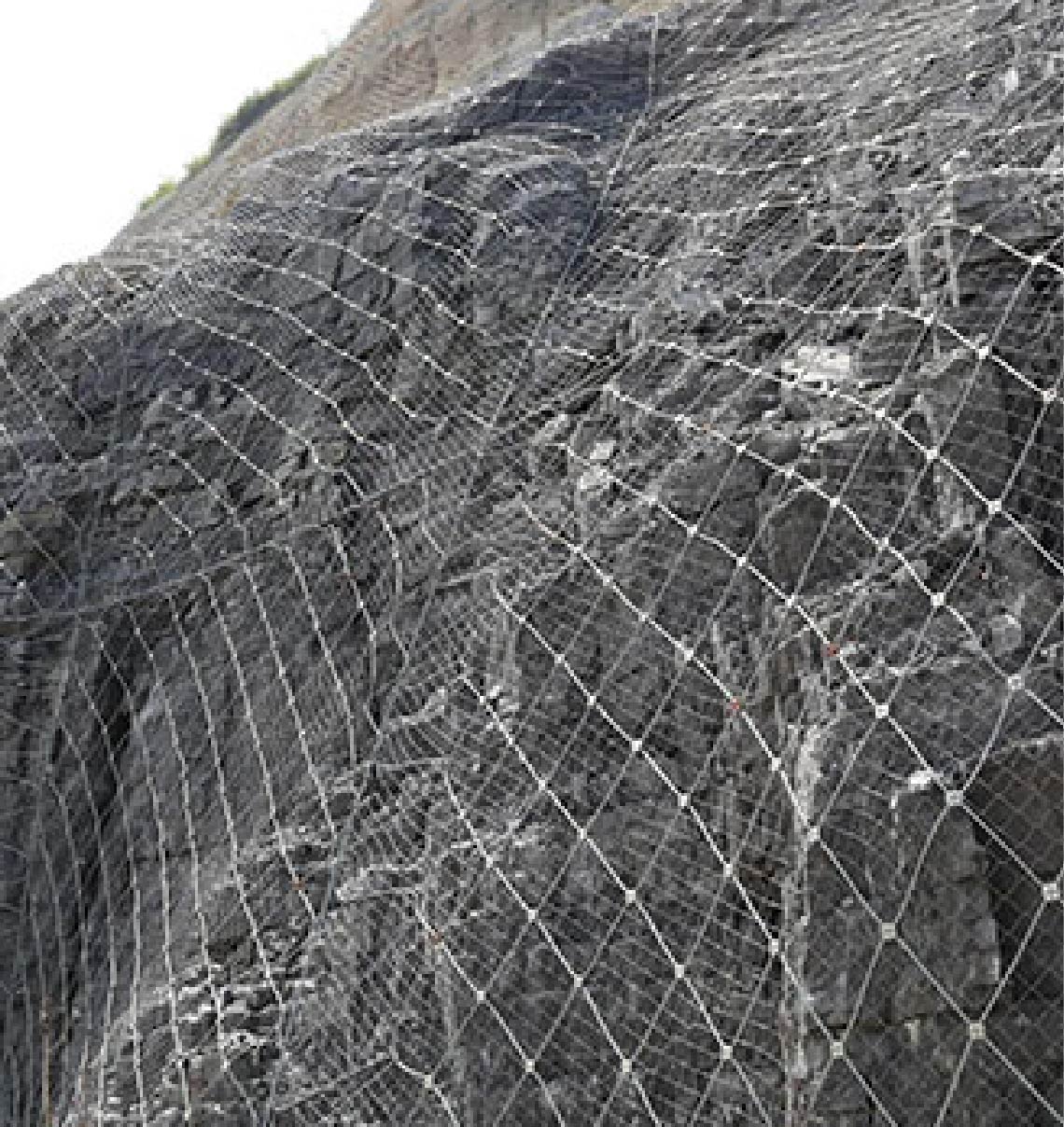
Draped systems are installed directly over the slope surface. As a result, detached rock fragments travel downward in a controlled manner instead of falling freely.
These systems are commonly applied where:
- Debris collection zones exist at the slope base.
- Continuous rock fragmentation occurs
- Large slope areas require protection.
Anchored Rockfall Protection Netting
Anchored systems secure unstable rock masses directly to the slope using rock bolts, anchors, and mechanical fastening systems.
Typical applications include:
- Road cut slopes
- Transportation corridors
- Mining excavations
- Localized instability zones
Additionally, engineers determine anchor spacing, embedment depth, layout, and load capacity through detailed geotechnical analysis based on rock quality and anticipated loading conditions.
High-Energy Barrier Systems
Unlike draped systems, barrier systems are installed away from the slope to intercept falling rocks before they reach infrastructure.
These systems absorb and dissipate impact energy while safely containing falling material. Furthermore, engineers classify barrier systems according to certified energy absorption capacities, allowing them to match the system to predicted rockfall impact energies.
How Rockfall Protection Netting Mitigates Rockfall Hazards
The performance of rockfall protection netting depends on several engineering mechanisms.
Surface Stabilization
Netting maintains close contact with unstable rock surfaces and limits the progressive detachment of fractured or weathered material.
In addition, effective surface and subsurface drainage reduces water infiltration, minimizes hydrostatic pressure, and slows weathering processes that accelerate rockfall activity.
Load Transfer and Restraint
Anchorage systems transfer loads generated by localized rock movement into reinforced zones of the rock mass. Consequently, they restrain unstable blocks and reduce the likelihood of progressive detachment.
Controlled Debris Movement
Instead of allowing rocks to fall freely, the system contains detached material and directs it toward designated collection areas.
Energy Dissipation
Where barrier systems are required, they absorb and distribute impact forces throughout the protective structure. As a result, the system reduces impact forces on nearby infrastructure while safely containing falling material.
Together, these mechanisms significantly reduce uncontrolled rockfall hazards and improve infrastructure safety.

Infrastructure Applications of Rockfall Protection Netting
Rockfall protection systems support a wide range of infrastructure sectors where unstable rock slopes threaten safety and long-term performance.
Roadway Construction
Roadway construction projects in mountainous terrain frequently require rockfall protection netting to safeguard road users, reduce maintenance requirements, and improve long-term infrastructure reliability.
In addition, these systems help maintain safe transportation corridors while minimizing disruptions caused by slope-related hazards.
Mining and Quarry Operations
Mining and quarry sites often contain steep excavated slopes that require continuous protection against falling rock and localized instability. Therefore, rockfall protection netting helps improve worker safety, protects equipment, and supports uninterrupted operations in demanding environments.
Hydropower and Energy Facilities
Hydropower stations, pipelines, transmission corridors, and other energy infrastructure often pass through challenging terrain. As a result, rockfall protection systems improve long-term reliability while reducing the risk of slope-related damage to critical assets.
Urban and Industrial Development
Urban expansion and industrial development increasingly extend into mountainous regions where rockfall hazards require engineered solutions. Consequently, rockfall protection netting helps protect buildings, industrial facilities, utility corridors, and surrounding infrastructure from falling debris.
Tunnels and Portals
Tunnel entrances and adjacent rock cuts frequently require protective netting systems to reduce exposure to falling rock hazards. Furthermore, these systems improve operational safety while reducing maintenance and road closures caused by rockfall events.
Integration with Retaining and Reinforced Earth Systems
In transportation and infrastructure projects, engineers often combine rockfall protection netting with reinforced earth walls, retaining structures, geogrid reinforcement systems, and erosion control measures.
This integrated approach provides effective rockfall mitigation while improving overall slope stability where additional reinforcement is required.
Depending on site conditions, engineers may combine rockfall protection netting with:
- Reinforced earth wall systems
- Uniaxial geogrid reinforcement
- Geocell erosion control systems
- Reinforced earth wall systems
Together, these geotechnical solutions improve infrastructure resilience, reduce maintenance requirements, and provide comprehensive slope protection for complex projects.
Durability and Long-Term Performance
Because rockfall protection systems operate in harsh outdoor environments, durability remains a critical design consideration.
Modern rockfall protection netting systems are engineered to resist:
- Corrosion exposure
- Mechanical loading
- Environmental degradation
- Repeated impact events
- Long-term weathering effects
High-strength steel components, protective coatings, and durable anchorage systems contribute to extended service life and lower maintenance requirements.
However, routine inspections remain essential throughout the design life of the system. Regular evaluations help verify anchor integrity, corrosion protection, and overall structural performance under changing site conditions.
Design Considerations for Rockfall Protection Netting
Successful implementation begins with a detailed geological and geotechnical investigation.
Key considerations include:
- Slope geometry
- Rock mass characteristics
- Geological discontinuities
- Joint spacing and orientation
- Block size estimation
- Impact energy requirements
- Anchor capacity
- Environmental exposure
- Drainage conditions
- Inspection and maintenance access
In addition, engineers may use rock mass classification systems such as Rock Mass Rating (RMR), discontinuity mapping, kinematic analysis, and rockfall trajectory analysis to evaluate potential failure mechanisms.
These engineering assessments help estimate block size, rockfall frequency, impact energy, and overall system performance requirements. Ultimately, loading conditions and hazard assessments remain the governing factors when selecting the most appropriate rockfall protection system. Therefore, every design should reflect the site’s geological conditions and project performance objectives.
Working with MEGS
MEGS delivers complete rockfall protection netting solutions through site investigation, geotechnical assessment, engineering design, material supply, and installation supervision.
Through its partnership with STRATA Geosystems, MEGS provides fully integrated geotechnical solutions that may include:
- Rockfall protection netting
- Reinforced earth systems
- StrataGrid™ geogrid reinforcement
- Slope stabilization systems
- Drainage geocomposites
- Erosion control solutions
Depending on project requirements, these systems can work together to address both rockfall hazards and overall slope stability. As a result, clients receive a complete engineering solution rather than a single protection measure.
By combining geotechnical engineering expertise with advanced geosynthetic technologies, MEGS helps clients improve safety, reduce project risks, and achieve reliable long-term infrastructure performance.

Sustainability and Risk Reduction Benefits
Rockfall protection netting contributes to sustainable infrastructure by reducing emergency repairs, protecting valuable assets, and extending infrastructure service life. In addition, these systems support more efficient construction while minimizing environmental impacts.
Additional benefits include:
- Reduced excavation requirements
- Lower environmental disturbance
- Improved infrastructure availability
- Reduced operational disruptions
- Enhanced public and worker safety
Consequently, these advantages support resilient infrastructure, reduce life-cycle costs, and promote more sustainable project development.
Conclusion
Rockfall protection netting has become an essential engineering solution for mitigating rockfall hazards and protecting infrastructure in high-risk environments.
By providing controlled containment, surface stabilization, drainage integration, and energy management, these systems significantly reduce geohazard exposure while supporting safe and reliable infrastructure operation.
Furthermore, successful rockfall mitigation depends on detailed geological investigations, accurate geotechnical design, and selecting systems that match site-specific loading conditions and hazard levels.
As development continues across mountainous terrain, roadway construction, mining operations, railway corridors, and critical infrastructure projects, rockfall protection netting will remain a key component of modern slope engineering and geohazard mitigation.
When engineers integrate rockfall protection netting with reinforced earth systems, StrataGrid™ geogrid reinforcement, drainage geocomposites, retaining structures, and erosion control solutions, they create comprehensive slope stabilization systems that improve safety, durability, and long-term infrastructure performance.
Through its partnership with STRATA Geosystems, MEGS delivers complete geotechnical solutions that combine international engineering expertise with proven geosynthetic technologies. As a result, clients benefit from safer infrastructure, lower maintenance requirements, and sustainable performance throughout the life of their projects.