
In modern geotechnical engineering, choosing the right reinforcement system is essential for long-term stability and performance. Among the most common options are uniaxial geogrid and biaxial geogrid systems. Each one serves a different purpose and performs best under specific ground conditions and loading requirements.
Therefore, understanding the difference between these systems helps engineers, contractors, and project owners choose the best solution for roadway construction, retaining walls, embankments, and other infrastructure projects.
At MEGS, we design, supply, and install geogrid systems as part of complete engineering solutions tailored to each project’s needs.

What is uniaxial geogrid and how does it work?
A uniaxial geogrid provides high tensile strength in one main direction. Because of this, it performs best where loads act mainly in a single direction.
The geogrid locks into the surrounding soil and forms a reinforced soil mass. As a result, it improves stability and resists lateral earth pressure.
For example, MEGS uses uniaxial geogrids in retaining walls, steep slopes, and embankments where controlled load transfer in one direction is essential.

What is biaxial geogrid and how does it work?
A biaxial geogrid provides strength in two directions. Therefore, it spreads loads more evenly through the soil and performs well under repeated or changing loads.
In pavement systems, the geogrid locks aggregate in place and creates strong lateral confinement. Consequently, it reduces deformation, increases bearing capacity, and improves pavement performance.
MEGS commonly uses biaxial geogrids in roadway construction and highway projects where long-term pavement performance is critical.
Key differences between uniaxial geogrid and biaxial geogrid
Load direction and strength behavior
The biggest difference is how each system carries loads.
A uniaxial geogrid provides strength in one direction. Therefore, it suits structures with predictable and directional forces.
In contrast, a biaxial geogrid spreads loads in two directions. As a result, it works better for roads and other traffic-loaded surfaces.
Application areas
Uniaxial geogrids support structural projects such as retaining walls, reinforced soil structures, steep slopes, and embankments.
Meanwhile, biaxial geogrids strengthen roadway construction, pavement systems, and weak subgrades.
Performance under dynamic loading
Biaxial geogrids handle repeated vehicle loads very well because they spread stresses in two directions.
However, uniaxial geogrids perform better where loads remain mostly static or act in one direction.
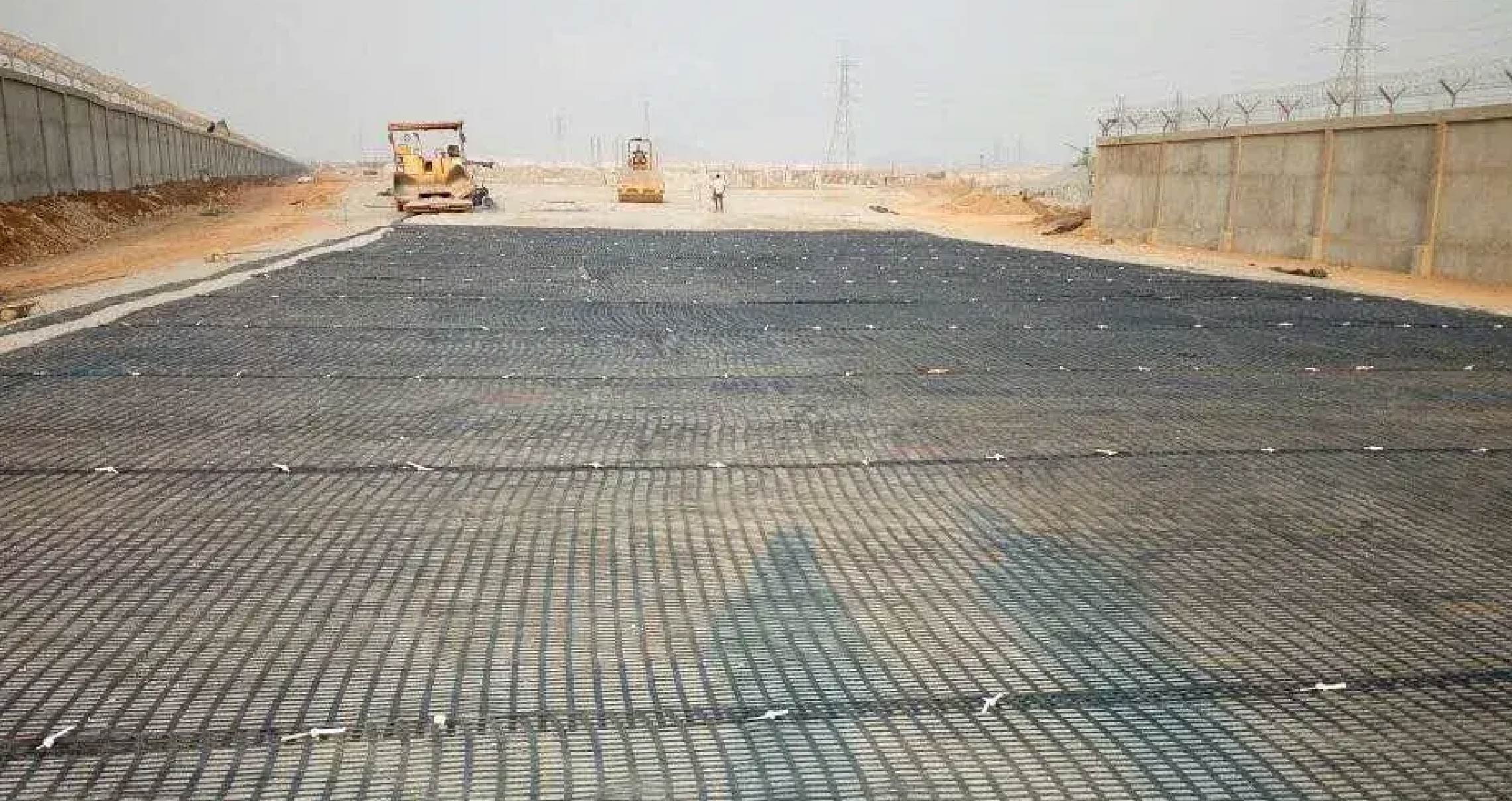
Applications of uniaxial geogrid in infrastructure
Uniaxial geogrids strengthen structures that require directional reinforcement.
Retaining wall systems
Uniaxial geogrid provides tensile strength to resist lateral earth pressure, making it essential in retaining wall design and mechanically stabilized earth (MSE) systems..
Embankments over soft soils
In weak soil conditions, uniaxial geogrid improves embankment stability by limiting settlement and distributing loads more effectively.
Steep slope stabilization
Uniaxial systems reinforce slopes and reduce the risk of failure by improving soil cohesion and resistance to movement.

Applications of biaxial geogrid in infrastructure
Biaxial geogrid is widely used in projects where load distribution and surface performance are critical
Roadway construction and pavement reinforcement
Biaxial geogrid improves pavement performance by reducing rutting, minimizing deformation, and extending service life
Subgrade stabilization
In weak soil conditions, biaxial systems increase bearing capacity and reduce the need for thick aggregate layers.
Industrial and heavy-load areas
Used in container yards and logistics zones, biaxial geogrid ensures stable performance under continuous heavy loads.
How to choose between uniaxial and biaxial geogrid
Choosing the correct system depends on the type of load, soil conditions, and project requirements.
When the application involves structural support with directional loads—such as retaining walls or slopes—uniaxial geogrid is the preferred solution. However, for projects involving traffic loads, such as roadway construction or highway systems, biaxial geogrid provides better performance due to its multidirectional strength.
At MEGS, system selection is based on detailed engineering analysis, ensuring that the chosen solution aligns with both design requirements and site conditions.
MEGS approach to geogrid solutions
MEGS delivers geogrid systems as complete solutions that integrate design, supply, and installation.
Each project begins with a detailed assessment of soil conditions, load requirements, and environmental factors. Based on this analysis, MEGS selects the appropriate geogrid system and ensures its proper installation on-site.
By combining advanced materials with engineering expertise, MEGS ensures that both uniaxial and biaxial geogrid systems perform effectively under real-world conditions.
Advantages of using the right geogrid system
Selecting the appropriate geogrid system improves structural performance, reduces material usage, and extends the lifespan of infrastructure. It also helps minimize maintenance costs while supporting environmental sustainability by optimizing resource use.
Conclusion
Choosing between uniaxial geogrid and biaxial geogrid plays an important role in successful infrastructure design. While uniaxial geogrids strengthen retaining walls, slopes, and embankments, biaxial geogrids improve roadway construction and pavement performance.
Therefore, selecting the right system improves durability, reduces costs, and delivers better long-term results.
Through its partnership with STRATA Geosystems, MEGS provides complete geogrid solutions that combine advanced products with engineering expertise. As a result, clients receive reliable, durable, and cost-effective ground reinforcement for a wide range of infrastructure projects.